

One hand to hold one han.., p.1
One Hand to Hold, One Hand to Carve, page 1
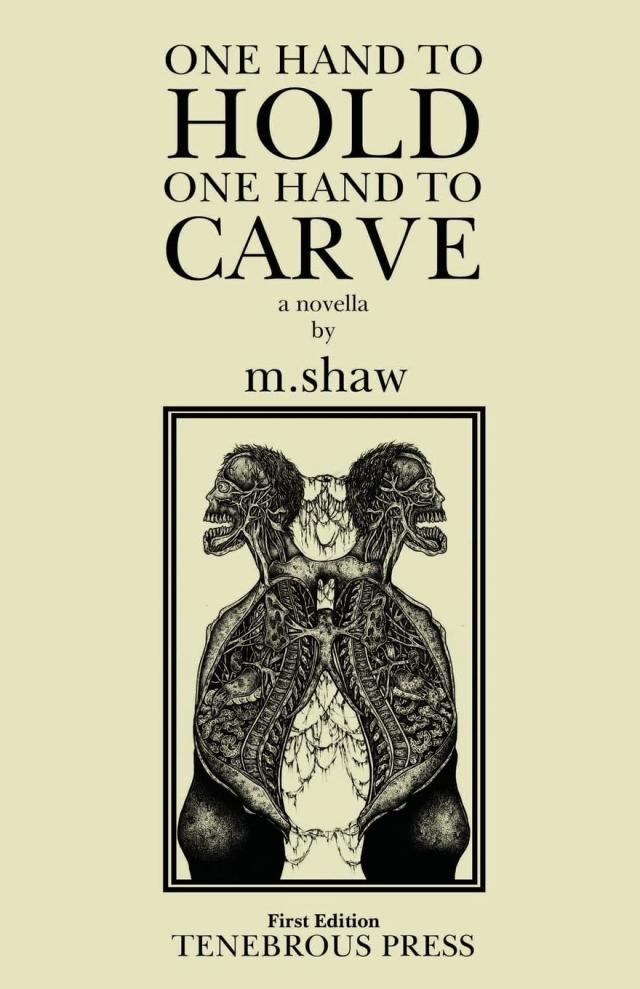


One Hand to Hold, One Hand to Carve
© 2022 by M.Shaw and Tenebrous Press
All rights reserved. No parts of this publication may be reproduced, distributed or transmitted in any form by any means, except for brief excerpts for the purpose of review, without the prior written consent of the owner. All inquires should be addressed to tenebrouspress@gmail.com.
Production of this novel was made possible in part by a grant from the Regional Arts & Culture Council. Visit https://racc.org/ for more information.
Published by Tenebrous Press.
Visit our website at www.tenebrouspress.com.
First Printing, April 2022.
The characters and events portrayed in this work are fictitious. Any similarity to real persons, living or dead, is coincidental and not intended by the author.
Front cover illustration and interior illustrations by Echo Echo.
Cover design by Matt Blairstone.
Formatting by Lori Michelle.
Printed in the United States of America.
For Bennett
ABOUT TENEBROUS PRESS
Tenebrous Press was conceived in the Plague Year 2020 and unleashed, howling and feral, in spring 2021 to deliver the finest in transgressive, progressive Horror from diverse and unsung voices around the world.
We welcome the esoteric; the unorthodox; the finest in New Weird Horror.
FIND OUT MORE:
www.tenebrouspress.com
Twitter: @TenebrousPress
NEW WEIRD HORROR
CHAPTER 1
“Ambidextrous” means “to have two right hands”
THEY AWAKE ON the table, in the dark, breathing in the meaty scent of death soaked in formaldehyde. The unpleasant knowledge of this smell is their first thought. Their second thought is that it is the smell of their own bodies wafting out of their open cavities. What was, moments ago, a human cadaver bisected to display a cross-section, has become two men with half a body, lit suddenly by the heat of consciousness, newborn in their decrepitude. Their exposed cavities face each other, forming a V where they were cleaved apart, edges ragged with tissue that rumples like lace trim. Their exposed organs pulse gently with new life, close enough for each of them to feel the warmth radiating from the other.
What comes next is the burning sensation of air brushing against the raw wound that covers each man from crown to crotch. A body recovering from hypothermia will gradually come to understand how much pain it is in as it thaws, and there is no shock colder than death where the flesh is concerned. As the pain builds, they are aware of it mostly as a curiosity, another fact among many that they struggle to reconcile with the impossibility of their awakening.
Their bodies would form mirror images of one another, but for the asymmetry of the conventional human corpse. The biggest difference is that only one of them feels a heart beating behind his ribs. This one—the left side—runs his finger along the ridge of his cranium, careful not to touch the soft gray matter inside. He tries to vocalize, but the sounds he produces are malformed by his half-mouth, his half-tongue.
The other one can hear the sounds only distantly. His ear faces down at the table, away from his brother, but he recognizes the source immediately. This is his first deduction: that there must be another half of him, somewhere nearby. He pushes a response from his throat, clumsy as it is. “Ah woo a’hwake?”
His brother tries, again, to speak. “Yeh,” he manages. “Uh I cuh . . . I cuh . . . I cah nah hfee woo.”
What would be gibberish to any other ear is given meaning by their parallel experience. Who better to understand than the only other creature on Earth who can?
“I cah nah shee woo eefah. Buh I wuh wike if I cuh . . . if I could.”
The man with the heart obliges, gripping the edge of the table to lever himself upright, twisting to drop his leg over the side. Formaldehyde pours from his cavity, cascading over bare organs, puddling beneath the edge of the table. His foot lands in the puddle when he hops down. He slips and nearly falls, catching himself with his elbow, then staggers more carefully and straightens on the leg.
His brother hears the sharp clang of the elbow on the stainless steel surface. “You ohay?”
“Yeh.”
“Dih a’yfing faw ouch?”
The man with the heart pats the soft edges of his share of the organs. “Nuh. Nu’hing feh. Fell. Nu’hing fell.” He pivots, bit by bit, hand on the table to steady himself, until he faces across it. And there, looking back at him, is his other half. This is the true moment of his birth, as it is anyone’s: the first confirmation that he has not come into the world to find himself alone.
They see each other, now, in a reflection that no two people have gazed upon before. Not a mirror image, or a photo, or a copy; each one looking at a body much like his own, and yet an entire separate person. Not a twin, but a kind of equal-opposite, naked and raw at the moment of their birth, with the dawning knowledge that the man across the table, looking back at him with a single eye, is having exactly the same thoughts. They are so transfixed that, for a brief moment, they cease to feel the burning of the air against their organs, or the terror of standing upright with their body cavities open. All each man has is the other, and maybe this is all each man needs, for now.
Eventually, the mere sight of each other is no longer answer enough for all their questions.
“Ah you wha’ I wook wike?” says the heartless one, shame pushing his voice into a lower register.
They are two halves of what was once a middle-aged man, and not a conventionally attractive one by most measures. Their skin has drained of the color it once had, and their movements are stiff and slow, heavy with the ghost of rigor mortis.
“I’m sowwy,” says the heart, even as he tries to find beauty in their sagging flesh, their wiry body hair, their toenails the color of pus. He wipes away a half-formed tear and, seeing no echo of this gesture in his brother, reflects that this is the first significant difference he has seen between them. He wonders if perhaps feelings are born in the heart after all. “You’a da white side.”
“And you’a da weft.”
And so they have put names to each other. The second connection of their relationship: first recognition, now identification. Right and Left.
So named, they converse, as much to compare thoughts as to practice articulating their consonants. They establish that neither of them remembers dying, or who they were before they died, or how it was that they came to live again. Neither of them remembers a family, a profession, a language other than English, a faith. Neither of them knows if their skin will heal over their open cavities, or if they will be like this forever. They know very little besides each other.
“I don’t think we can stay here,” says Right, when the conversation lulls. His eye sweeps over this workshop of the body, full of tables like the one they were on a minute ago. This is a school, he realizes, a school of anatomy. All the tables are empty, but the same embalmed odor pervades the entire facility. “This is a place for the dead, not the living.”
“Living.” Left hold his hand before his face.
“Like us,” says Right. “We’re alive, aren’t we?”
“But where would we go?” asks Left, still staring at his hand. He is fascinated by the creases of his palm, the whorls of his fingerprints; terrified of what it means to live inside such complexity while simultaneously in awe of it. He wonders if it’s correct to think that these fingerprints once belonged to a different person, and if so, whether anyone else has ever passed on their fingerprints to another like this.
Right considers the question. Where do I want to go, he asks himself, imagining rooms more pleasant than this one. Places with generous chairs and tables meant for dining, lights that are soft and warm, windows that show a world more beautiful than this human cutting room. “How about a cottage?”
“A cottage,” Left says flatly.
Right nods, cautious not to do it too vigorously as he holds his posture. “You know, a little house in the woods, away from this. No stainless steel, no smell of decay. A place with a garden, maybe even some animals. A porch where we could sit and carve little figures out of wood. You could hold the block steady while I work with the knife.”
“I meant, where can we go now,” says Left. “I’m thinking more along the lines of one of those motels with weekly rates.”
“Oh. Well. Yeah,” says Right. “I guess that makes more sense in the short term. The cottage can come later. We’ll just have to find one, and some woods.”
“It does sound nice,” says Left. “Maybe one day.”
They experiment more with moving around. By themselves, they can only hop, which poses problems given the delicate, unsteady towers of their bodies. One hand is not enough to hold everything in place. Left’s intestines fall out during one attempt, and it takes both of them working in concert to fit everything back where it belongs. Eventually, they realize that if they each wrap their arm around the other’s hip, they can hug their bodies together and approximate a two-legged walk.
It is an awkward process, shuffling themselves together without being able to look where they are going. Right gropes for Left’s hip once they are close enough, guiding them in. In the moment before their open sides meet, Left wonders if their half-brains will meld together when they touch. His heart quickens with the fear that these few minute
Right, meanwhile, wonders if their organs will spill into each other’s cavities while they are together. He imagines them mingling and sticking, rendering him unable to separate from his twin, and this fills him with an anxiety not quite parallel with Left’s.
Left feels the hand on his hip, and reciprocates, and it is done. No fusion occurs. They still cannot see each other, but they can feel the soft wax and wane of each other’s lungs, never quite in sync.
“I’ll step first,” says Right. “When you see my foot land, then you step.”
It is not a perfect plan. Left’s first step is more of a hop, causing them both great pain as the edges of their pelvic bones scrape together. They realize each one needs to lean slightly on the other as he steps. This works better, but creates a clownish, swaying gait, as they find when they discover a mirror in the nearby locker room. They also find a set of hospital scrubs and manage, while seated on the bench, to shuffle their bodies into the trousers, the shirt.
At a nurse’s station, they find a pair of crutches. Left adopts one. Adding it to the rhythm of their motion, they practice until they are able to walk reliably, learning to sense each other’s movements through touch. First the crutch and Right’s foot, then Left’s foot swinging between them. The sensation between them is friction on parts of the body that should never experience it, and they quickly find that pain has become a secondary language through which they communicate unspoken. They hobble down the hallways of the empty hospital wing, a work in progress, a labor of love.
They find the exit. It’s dark outside, but not so dark as inside the building. Encased in a single garment, “walking” with the crutch, they appear to any incidental observers as a sickly, disoriented, injured man. As such, they are largely ignored by the few other people walking the streets this time of night, who do not want to be reminded of the frailty of their own bodies so explicitly.
The smells outside are mercifully fresher than those in the lab. The school is in a suburban area, where the air is thick with moisture and floral blooms. They meander barely-lit streets, crowded on either side by dense brush that blends together in the dark, forming an endless tangled, black mass. Air conditioners hum all around them in one collective harmony, like a call to prayer.
In the privacy of the side streets, they practice talking as if from a single mouth. They cannot read each other’s thoughts, but with their single brain hemispheres so close, their newly awakened spinal nerves firing in tandem, it feels so much like they could, if only they tried hard enough. And so, they try words. Individual words, to start with. Left thinks of one, and focuses intently on sending it across the thin membrane of air where their minds intersect. Right listens for hints of the word, in whatever part of him is not a body part, and then they try to pronounce it together.
“Hwulghtwah,” it comes out the first time.
“Fthelwroch,” the second. Vowels and consonants compound, forming a multi-tonal hiss that would normally be impossible for a mouth to produce.
Somehow, the longer they keep at it, the more they learn of each other’s unspoken bodily code. By the time the sky grays with dawn’s light, they are closer than ever. “Hwellyo,” they drawl. Then, “Bwothwer. My bwot’ther.” Then, “Hwoulfe. Hlove. Aye wlove yhoo.” Left cracks a smile and the next word comes out unintelligible. If he knows nothing else, blanked as he is from the amnesia of death, he at least knows that he will always have this. He will always have another half who loves him.
They aren’t able to find a motel before exhaustion overtakes them. Despite the rising sun, they find themselves quickly wearied from their first day of being alive, and bed down in a ditch alongside a cornfield. They cover themselves with brush and fall asleep, each one holding the other to himself, lest they lose track of each other while unconscious.
***
They do find a motel the following day, and struggle through explaining their needs to a concierge who stands as far back from the desk as he physically can while talking to them. He mutters something about payment and Right passes him a credit card they found in the road, covered with a patina of grime and nearly split down the middle. The concierge pushes a key across the counter and points them toward the rear of the building, clearly eager to end the encounter as quickly as possible and return to his phone game. If the card is declined when he tries to run it, the brothers never hear about it.
That night, they go around collecting change from beneath drive-thru windows, then stumble into a thrift store at dawn with enough for a cart full of 95-cent garments to share. Back at the motel, they find that their skin is indeed healing over their open sides. After a few days, when they are finally closed, and their faces have lost their grey-yellow pallor in favor of a more creamy pink, they begin to improvise a life.
After a few days of trial and error, they figure out how to rig, for each of them, a homemade prosthesis using pillows, broom handles, and duct tape, most of it pilfered from housekeeping. While wearing it, each brother is able to appear merely as a horribly disfigured man with half a face, rather than a reanimated corpse with half a body. A few more days experimenting with their accumulating piles of thrift clothes, and they develop their own preferences in outfits as well. Right finds that he favors whimsically patterned button-down shirts tucked into bluejeans; Left tries to follow suit, but eventually settles for his own, more casual outfits of track pants and oversized t-shirts.
On one of their thrift runs, they find an old laptop that still works within their budget. Right uses it to get a job when the motel starts being more aggressive about payment. It’s just as well; their initially lean appetites are building by the day, and it’s getting harder to feed themselves with scavenged coins. Left can’t get a job; lacking a dominant hand, he cannot write and doesn’t have the dexterity required for most types of work, so they both rely on Right’s income. Left, instead, handles the domestic duties, buys groceries, cleans up, feeds them both. This is still difficult work, but in their motel room he is free to curse, stumble, and cry as much as he needs to push through it.
When they aren’t busy trying to locate any bootstrap they can possibly pull, they discuss Right’s idea of a cottage in more detail. Left suggests it should have two stories; Right adds that it should have a cellar. Right describes the stone hearth; Left, the split timber walls; Right makes sure to add a bench for them to work with wood; Left is not really interested in carving wood, but allows it. Day by day they map the interior, the décor, the garden, the surrounding woods. It becomes the source of joy they cling to, despite their frustrations, despite how little they are able to do together, much less by themselves.
At work, Right wears a headset through which he places phone calls. After a time, when he has proven himself, he is moved to a desk where he receives calls instead. He follows scripts and enters commands into a computer. Easy work, as long as one can handle spending all day talking to people who are disgusted just to be having the conversation. No one except Left has ever reacted favorably to Right, so dealing with this is second nature. He takes the bus to work—almost 2 hours each way—until they come up with enough money to buy a used car, a badly rusted compact model that stops and goes and not much else.
Between calls, and during his breaks, he works on the cottage by himself, purely within his own imagination. At first, this only happens because Left doesn’t want to talk about a workshop for wood carving, so it’s the workshop he fleshes out first. After that, he finds that it keeps going. He adds a guest bedroom, and adorns the master with two twin beds, their headboards cut from the same giant tree trunk.
Soon, he realizes that there are now two versions of the cottage: the one that exists for both him and his brother, and the one that only exists for himself. He decides to hold on to the latter. It is just for him.






