Wizards of odd, p.1
Wizards of Odd, page 1


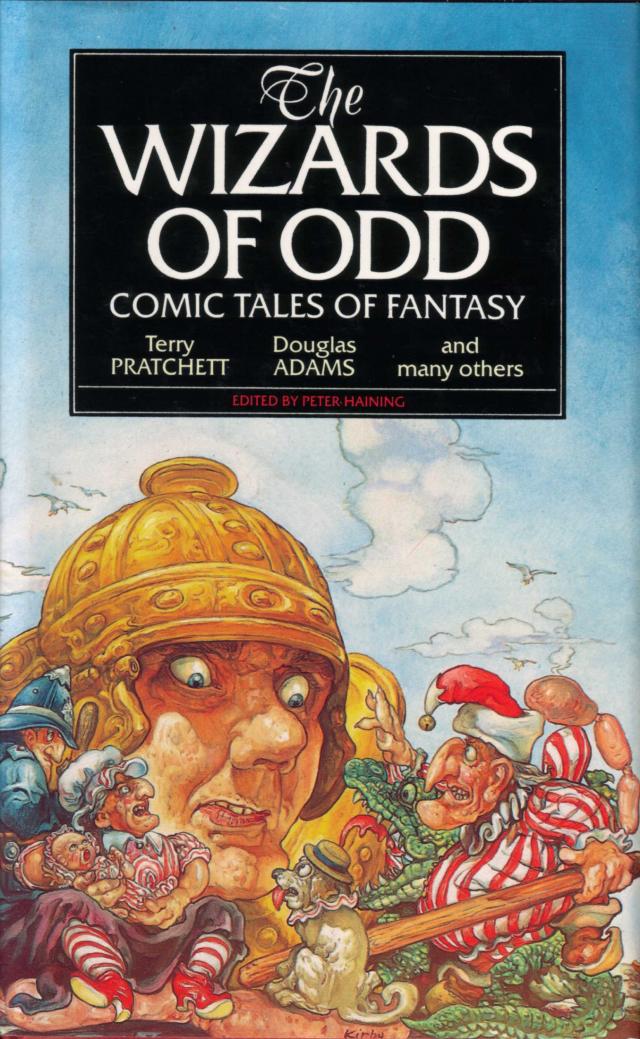
THE WIZARDS OF ODD
COMIC TALES OF FANTASY
Edited by Peter Haining
Copyright © 1996
Also edited by Peter Haining
GREAT IRISH STORIES OF THE SUPERNATURAL
GREAT IRISH TALES OF THE UNIMAGINABLE
GREAT IRISH TALES OF HORROR
Sport that wrinkled Care derides,
And Laughter holding both his sides.
Come, and trip it as ye go
On the light fantastic toe ...
--John Milton
Table of Contents
INTRODUCTION
WIZARDS AND WOTSITS THEATRE OF CRUELTY by Terry Pratchett
HOW NUTH WOULD HAVE PRACTICED HIS ART UPON THE GNOLES by Lord Dunsany
HELL HATH NO FURY by John Collier
THE TWONKY by Henry Kuttner
A GREAT DEAL OF POWER by Eric Frank Russell
DOODAD by Ray Bradbury
NOT BY ITS COVER by Philip K. Dick
THE RULE OF NAMES by Ursula K. Le Guin
SWORDS AND SORCERY MYTHOLOGICAL BEAST by Stephen Donaldson
THE ADVENTURE OF THE SNOWING GLOBE by F. Anstey
AFFAIRS IN POICTESME by James Branch Cabell
THE RING OF HANS CARVEL by Fredric Brown
THE BAIT by Fritz Leiber
A GOOD KNIGHT’S WORK by Robert Bloch
POOR LITTLE WARRIOR by Brian W. Aldiss
THE ODD OLD BIRD by Avram Davidson
ASTRONAUTS AND ALIENS YOUNG ZAPHOD PLAYS IT SAFE by Douglas Adams
THE WILD ASSES OF THE DEVIL by H. G. Wells
MINISTERING ANGELS by C. S. Lewis
THE GNURRS COME FROM THE VOODVORK OUT by Reginald Bretnor
CAPTAIN WYXTPTHLL’S FLYING SAUCER by Arthur C. Clarke
PLAYBOY AND THE SLIME GOD by Isaac Asimov
THERE’S A WOLF IN MY TIME MACHINE by Larry Niven
2BRO2B by Kurt Vonnegut Jr.
ACKNOWLEDGEMENTS
INTRODUCTION
As a child I once lay awake for hours half-hoping to see a Dufflepud. Remember them? They were supposed to look rather like mushrooms, bounced around like footballs and were always agreeing with each other in loud voices. One person who did see them called them, simply, ‘the funnies’.
The Dufflepuds were not just amusing, though: they did things that stuck in the imagination. They washed up plates and knives before dinner because, they said, that saved them having to do them afterwards. They planted boiled potatoes so that they were ready for eating when they were dug up. And there was also the time when a cat got into a dairy and began lapping up the pails of milk. What did the Dufflepuds do? They didn’t shoo the cat out, of course—they moved all the milk.
If any readers are still puzzled, let me remind them. The Dufflepuds were just one of C. S. Lewis’ magical creations in his book that no child should miss or neglect to reread as an adult: The Voyage of the Dawn Treader. It is a classic, the book that introduced me to humorous fantasy fiction more than forty years ago and to which I have had good reason to be grateful ever since.
Another episode of comic fantasy, this time from the cinema, remains equally vivid in my mind although I was an adult when I saw it. It was a moment of genius by that multitalented writer and director, Woody Allen. The movie was a kind of futuristic satire on sex, and the episode in question concerned a mad scientist who had created a huge, mobile female breast. In the best tradition of horror films and ‘B’ movies, the breast had broken free from the scientist’s laboratory and was crushing everything that got in its way. But good old Woody found the solution to the marauding mammary: he brought its ravages to a dramatic end by trapping it in the cup of a giant bra! For those who don’t remember the title, the picture was called Everything You Always Wanted to Know About Sex But Were Afraid to Ask (1972).
Although these experiences happened to me at very different periods of my life, they have something very fundamental in common. They are linked by what C. S. Lewis described as the key to the fantasy story—’an arresting strangeness’.
Which brings me to what I believe is perhaps the best argument for the appeal of fantasy fiction in general and humorous fantasy in particular. In all such stories the reader will encounter people, places, occurrences and creatures that, according to normal standards or scientific explanations, should not exist. That is what stimulates the imagination. And the degree to which the stimulation captures the reader’s mind determines the success or failure of the genre.
It was another of the masters of fantasy, Professor J. R. R. Tolkien, who remarked that the object of fantasy is to fill the reader with ‘awe and wonder’. If we add to this the words ‘and to amuse’, then we have a pretty good definition of humorous fantasy and certainly of the aim of the stories in this collection.
Like all literary genres, comic fantasy has various subdivisions, and in this book I have tried to arrange the stories under three headings which divide the categories as clearly as I have been able to manage. Firstly, ‘Wizards and Wotsits’. These are all tales of magic and the supernatural in which neither works quite as it should. The second section, ‘Swords and Sorcery’, actually evolved from one of the oldest of all literary forms, with its antecedents in the ancient Greek legends and Scandinavian sagas. This brand of heroic fantasy has today undergone something of an upheaval: the heroes have become a lot more fallible, their quests rather less glamorous and their adversaries…well, find out all about that for yourself.
The ‘Space Opera’ is the last and most recent development in humorous fantasy. Space travel is generally regarded as such a highly technical and scientific pursuit that it seems almost profane to make fun of it—yet that is precisely what some very distinguished SF writers have done, with the result that the astronauts and aliens who appear in the last third of the book are neither supermen nor superintelligences from other worlds, of the kind who, in a host of books from the turn of the century onwards, have been trying to show man the folly of his ways in something approaching a messianic crusade!
Whenever I find myself reading stories like these, I am reminded of a couple of lines from Lewis Carroll’s Alice’s Adventures in Wonderland, a work which has, directly and indirectly, been very influential on writers in the genre. They are lines spoken by the ubiquitous Mad Hatter: ‘Up above the world you fly,’ he remarks with all the seeming knowledge of personal experience, ‘Like a tea tray in the sky.’ It is not just tea trays that the writers of fantasy fiction have wrought for our imagination, but an absolute flotilla of craft, from H. G. Wells’ ungainly Martian tripods to Doctor Who’s improbable Tardis!
There is no doubt that the current popularity of humorous fantasy owes a great deal to two of my contributors, Terry Pratchett and Douglas Adams. The other writers have all made important contributions, but Pratchett and Adams have become famous specifically as comic writers. I am therefore especially pleased that both so readily agreed to contribute to this book and provided what are to date the only short stories about their best-known creations: the Discworld moving through space on the backs of four elephants supported by a giant turtle, and the Hitch-Hiker’s Guide charting the unlikely geography of the galaxy—two more examples of ‘arresting strangeness’ if ever I read them. Furthermore, both authors have revised their landmark stories for this, their first anthology appearance.
The Wizards of Odd represents, I believe, some of the best comic fantasy writing of the past one hundred years. It is not definitive—a volume three times the size would be needed to encompass all the contributors to the genre—but it is fully representative. And each story will, I hope, cause the reader to echo another line by Lewis Carroll: ‘“Curiouser and curiouser,” said Alice.’
PETER HAINING,
Boxford, Suffolk.
1
WIZARDS AND WOTSITS
Stories of Cosmic Absurdity
THEATRE OF CRUELTY
Terry Pratchett
The comic fantasy genre is today dominated by Terry Pratchett whose series of eighteen Discworld novels, which he began writing in 1983 with The Colour of Magic, are one of the publishing phenomena of the last decade. Each new title automatically becomes a bestseller as it is published, and the books have also been translated into eighteen languages, generated a host of spin-off merchandising, are soon to become a major Granada TV serial, and, with the exception of J. R. R. Tolkien’s The Lord of the Rings, have probably done more to popularise fantasy fiction than any other series.
Where Pratchett differs from Tolkien, however, is that all his stories are outlandishly funny. Discworld is a place of magic which rests on the back of four giant elephants who in turn stand on the shell of a gargantuan turtle (‘sex unknown’), journeying through starry infinity. It is peopled with bizarre characters, a number of whom have emerged as the novels progressed to be the most popular with readers. They include the hopeless wizard, Rincewind; the venerable witch, Granny Weatherwax; the orangutan Librarian of Unseen University; Death, who speaks in capital letters and rides a white horse called ‘Binky’; and, especially, Luggage, a wooden chest with multiple legs who has been described as half faithful companion and half psychotic killer.
Terry Pratchett (1948—) has admitted that his interest in fantasy was influenced by reading Kenneth Grahame’s The Wind in the Willows while he was still a schoolboy in his home town of Beaconsfield. He began writing stories soon afterwards, and at 13 became one of that select band of writers to have had their first story published while still in their teens—in Pratchett’s case a l
‘Theatre of Cruelty’ is an important story in several respects. It is to date the only Discworld short story Pratchett has written, and has only previously appeared in W. H. Smith’s free magazine, Bookcase, in the July/August 1993 edition where it was published in a shortened form and not even mentioned on the front cover! For this, its very first appearance in a book, ‘Theatre of Cruelty’ has been especially restored by the author to its original length. The story is a gem of cosmic absurdity which sets the standard for all those that are to follow. . .
* * * *
It was a fine summer morning, the kind to make a man happy to be alive. And probably the man would have been happier to be alive. He was, in fact, dead.
It would be hard to be deader without special training.
‘Well, now,’ said Sergeant Colon (Ankh-Morpork City Guard, Night Watch), consulting his notebook, ‘so far we has cause of death as a) being beaten with at least one blunt instrument, b) being strangled with a string of sausages and c) being savaged by at least two animals with big sharp teeth. What do we do now, Nobby?’
‘Arrest the suspect, sarge,’ said Corporal Nobbs, saluting smartly.
‘What suspect, Nobby?’
‘Him,’ said Nobby, prodding the corpse with his boot. ‘I call it highly suspicious, being dead like that.’
‘But he’s the victim, Nobby. He was the one what was killed.’
‘Ah, right. So we can get him as an accessory, too.’
‘Nobby—’
‘He’s been drinking, too. We could do him for being dead and disorderly.’
Colon scratched his head. Arresting the corpse offered, of course, certain advantages. But…
‘I reckon,’ he said slowly, ‘that Captain Vimes’ll want this one sorted out. You’d better bring it back to the Watch House, Nobby.’
‘And then can we eat the sausages, sarge?’ said Corporal Nobbs.
* * * *
It wasn’t easy, being the senior policeman in Ankh-Morpork, greatest of cities of the Discworld.1 There were probably worlds, Captain Vimes mused in his gloomier moments, where there weren’t wizards (who made locked room mysteries commonplace) or zombies (murder cases were really strange when the victim could be the chief witness) and where dogs could be relied on to do nothing in the night time and not go around chatting to people. Captain Vimes believed in logic, in much the same way as a man in a desert believed in ice—i.e., it was something he really needed, but this just wasn’t the place for it. Just once, he thought, it’d be nice to solve something.
He looked at the blue-faced body on the slab, and felt a tiny flicker of excitement. These were clues. He’d never seen proper clues before.
‘Couldn’t have been a robber, captain,’ said Sergeant Colon. ‘The reason being, his pockets were full of money. Eleven dollars.’
‘I wouldn’t call that full,’ said Captain Vimes.
‘It was all in pennies and ha’pennies, sir. I’m amazed his trousers stood the strain. And I have cunningly detected the fact he was a showman, sir. He had some cards in his pocket, sir. “Chas. Slumber, Children’s Entertainer”.’
‘I suppose no one saw anything?’ said Vimes.
‘Well, sir,’ said Sergeant Colon helpfully. ‘I told young Corporal Carrot to find some more witnesses.’
‘You asked Corporal Carrot to investigate a murder? All by himself?’ said Vimes.
The sergeant scratched his head.
‘Yessir. I said he ought to try to find a witness, sir. And he said to me, did I know anyone very old and seriously ill?’
And on the magical Discworld, there is always one guaranteed witness to any homicide. It’s his job.
Corporal Carrot, the Watch’s youngest member, often struck people as simple. And he was. He was incredibly simple, but in the same way that a sword is simple, or an ambush is simple. He was also possibly the most linear thinker in the history of the universe.
He had been waiting by the bedside of an old man, who’d quite enjoyed the company right up until just a few seconds ago, whereupon he’d passed on to whatever reward was due him. And now it was time for Carrot to take out his notebook.
‘Now I know you saw something, sir,’ he said. ‘You were there.’
WELL, YES, said Death. I HAVE TO BE, YOU KNOW. BUT THIS IS VERY IRREGULAR.
‘You see, sir,’ said Corporal Carrot, ‘as I understand the law, you are an Accessory After The Fact. Or possibly Before The Fact.’
YOUNG MAN, I AM THE FACT.
‘And I am an officer of the Law,’ said Corporal Carrot. ‘There’s got to be a law, you know.’
YOU WANT ME TO ... ER ... GRASS SOMEONE UP? DROP A DIME ON SOMEONE? SING LIKE A PIGEON? NO. NO ONE KILLED MR SLUMBER. I CAN’T HELP YOU THERE.
‘Oh, I don’t know, sir,’ said Carrot, ‘I think you have.’
DAMN.
Death watched Carrot leave, ducking his head as he went down the narrow stairs of the hovel.
NOW THEN, WHERE WAS I...
‘Excuse me,’ said the wizened old man in the bed, ‘I happen to be 107, you know. I haven’t got all day.’
AH, YES. CORRECT.
Death sharpened his scythe. It was the first time he’d ever helped the police with their enquiries. Still, everyone had a job to do.
Corporal Carrot strolled easily around the town. He had a Theory. He’d read a book about Theories. You added up all the clues, and you got a Theory. Everything had to fit.
There were sausages. Someone had to buy sausages. And then there were pennies. Normally only one sub-section of the human race paid for things in pennies.
He called in at a sausage maker. He found a group of children, and chatted to them for a while.
Then he ambled back to the scene of the crime in the alley, where Corporal Nobbs had chalked the outline of the corpse on the ground (colouring it in, and adding a pipe and a walking stick and some trees and bushes in the background—people had already dropped 7p in his helmet). He paid some attention to the heap of rubbish at the far end, and then sat down on a busted barrel.
‘All right…you can come out now,’ he said, to the world at large. ‘I didn’t know there were any goblins left in the world.’
The rubbish rustled. They trooped out—the little man with the red hat, the hunched back and the hooked nose, the little woman in the mob cap carrying the even smaller baby, the little policeman, the dog with the ruff around its neck, and the very small alligator.
Corporal Carrot sat and listened.
‘He made us do it,’ said the little man. He had a surprisingly deep voice. ‘He used to beat us. Even the alligator. That was all he understood, hitting things with sticks. And he used to take all the money the dog Toby collected and get drunk. And then we ran away and he caught us in the alley and started on the Judy and the baby and he fell over and—’
‘Who hit him first?’ said Carrot.
‘All of us!’
‘But not very hard,’ said Carrot. ‘You’re all too small. You didn’t kill him. I have a very convincing statement about that. So I went and had another look at him. He’d choked to death on something. What is this?’
He held up a little leather disc.
‘It’s a swozzle,’ said the little policeman. ‘He used it for the voices. He said ours weren’t funny enough.’
‘ “That’s the way to do it!” ’ said the one called Judy, and spat.
‘It was stuck in his throat,’ said Carrot. ‘I suggest you run away. Just as far as you can.’
‘We thought we could start a people’s co-operative,’ said the leading gnome. ‘You know…experimental drama, street theatre, that sort of thing.’
‘Technically it was assault,’ said Carrot. ‘But frankly I can’t see any point in taking you in.’
‘We thought we’d try to bring theatre to the people. Properly. Not hitting each other with sticks and throwing babies to crocodiles—’